

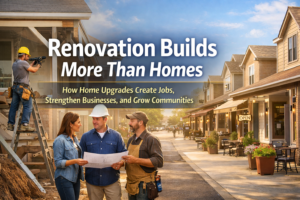
Home improvement is often viewed as a personal investment—something homeowners do to enhance comfort, improve aesthetics, or increase property value. Yet the true impact of renovation extends far beyond individual properties. Home upgrades play a significant role in strengthening local economies, creating employment opportunities, supporting the retention and expansion of existing businesses, encouraging the development of new enterprises, and ultimately increasing the local tax base that funds essential public services.
When communities invest in housing improvements, they are not just building better homes—they are building stronger economies.
Home Improvement as a Driver of Employment
Every renovation project, whether large or small, requires skilled labor. Carpenters, electricians, plumbers, painters, roofers, HVAC technicians, flooring specialists, and project managers all play a role in transforming homes. In addition to these trades, renovation projects support jobs in manufacturing, logistics, retail supply stores, engineering, and design.
This network of professionals forms a vital employment ecosystem. As demand for renovation grows, contractors hire more workers, suppliers expand operations, and training opportunities increase for skilled trades. This steady demand helps stabilize the workforce, allowing businesses to retain experienced employees and invest in long-term growth.
Unlike many industries that fluctuate dramatically, housing maintenance and improvement provide consistent work because homes always require upkeep, modernization, and adaptation to changing needs.
Supporting Business Retention and Expansion
Local businesses depend on steady economic activity to survive and thrive. Home improvement projects provide that stability. Hardware stores, building material suppliers, equipment rental companies, cabinetry manufacturers, and landscaping businesses all benefit when renovation activity is strong.
When these businesses experience consistent demand, they are more likely to:
-
Retain skilled employees
-
Expand their facilities or services
-
Invest in better equipment and technology
-
Open additional locations in growing communities
Strong renovation markets help prevent business closures and encourage reinvestment in local economies. This stability strengthens the entire business ecosystem, creating a ripple effect that benefits industries far beyond construction.
Encouraging the Development of New Businesses
Revitalized neighborhoods attract entrepreneurs. When homes are well maintained and communities appear vibrant and safe, new businesses are more likely to open nearby. Restaurants, cafés, service providers, retail shops, and professional offices often follow residential improvements.
Developers and investors are also more willing to finance new projects in areas where housing conditions are improving. As property values stabilize or rise, confidence in the local market increases, making it easier for new businesses to secure funding and establish operations.
Home improvement, therefore, becomes a catalyst for broader economic development, stimulating both residential and commercial growth.
Strengthening Housing and Community Infrastructure
Upgraded housing improves not only individual properties but entire neighborhoods. Modernized homes are more energy efficient, safer, and better suited to contemporary lifestyles. Improvements such as insulation upgrades, solar energy systems, modern roofing, and improved drainage contribute to sustainability and resilience.
When multiple homes in a neighborhood are renovated, the area becomes more desirable to both residents and investors. This helps stabilize housing markets, reduce vacancy rates, and encourage long-term residency—factors that contribute to stronger, more cohesive communities.
In growing regions, renovation also complements new housing development. Instead of relying solely on new construction, communities can preserve existing housing stock while adapting it to modern standards, creating balanced and sustainable growth.
Increasing the Local Tax Base
One of the most important long-term benefits of home improvement is its impact on property values and tax revenue. Renovated homes typically increase in assessed value, which contributes to higher property tax revenue for local governments.
This increased revenue helps fund:
-
Schools and educational programs
-
Roads and infrastructure improvements
-
Emergency services and public safety
-
Parks and community facilities
-
Utilities and environmental initiatives
A stronger tax base allows municipalities to reinvest in public services, which further enhances quality of life and attracts new residents and businesses. This positive cycle reinforces long-term economic stability.
Revitalization and Community Confidence
Beyond financial metrics, renovation plays an important psychological and social role. Well-maintained homes signal pride, care, and stability. Neighborhoods that undergo revitalization often experience reduced crime rates, increased community engagement, and stronger relationships among residents and local businesses.
When people feel confident in their surroundings, they are more likely to invest in their homes, start businesses, and participate in community initiatives. This sense of momentum can transform entire districts over time.
Long-Term Economic Sustainability
Home improvement contributes to sustainable economic growth because it builds on existing infrastructure rather than relying solely on new development. Renovating and upgrading homes is often more resource-efficient than constructing entirely new buildings, and it helps preserve architectural character and cultural identity within communities.
Sustainable renovation practices—such as energy-efficient materials, water-saving systems, and environmentally friendly construction methods—also reduce long-term operating costs for homeowners and lower environmental impact.
As sustainability becomes increasingly important worldwide, home improvement will continue to play a central role in responsible development.
Conclusion
Renovation is far more than a cosmetic upgrade—it is a powerful engine of economic growth. Home improvements create jobs, support the retention and expansion of local businesses, encourage the development of new enterprises, strengthen housing markets, and increase the tax base that funds essential public services.
Communities that invest in strong housing infrastructure lay the foundation for long-term prosperity. By improving homes today, we help build resilient economies, thriving neighborhoods, and sustainable communities for the future.